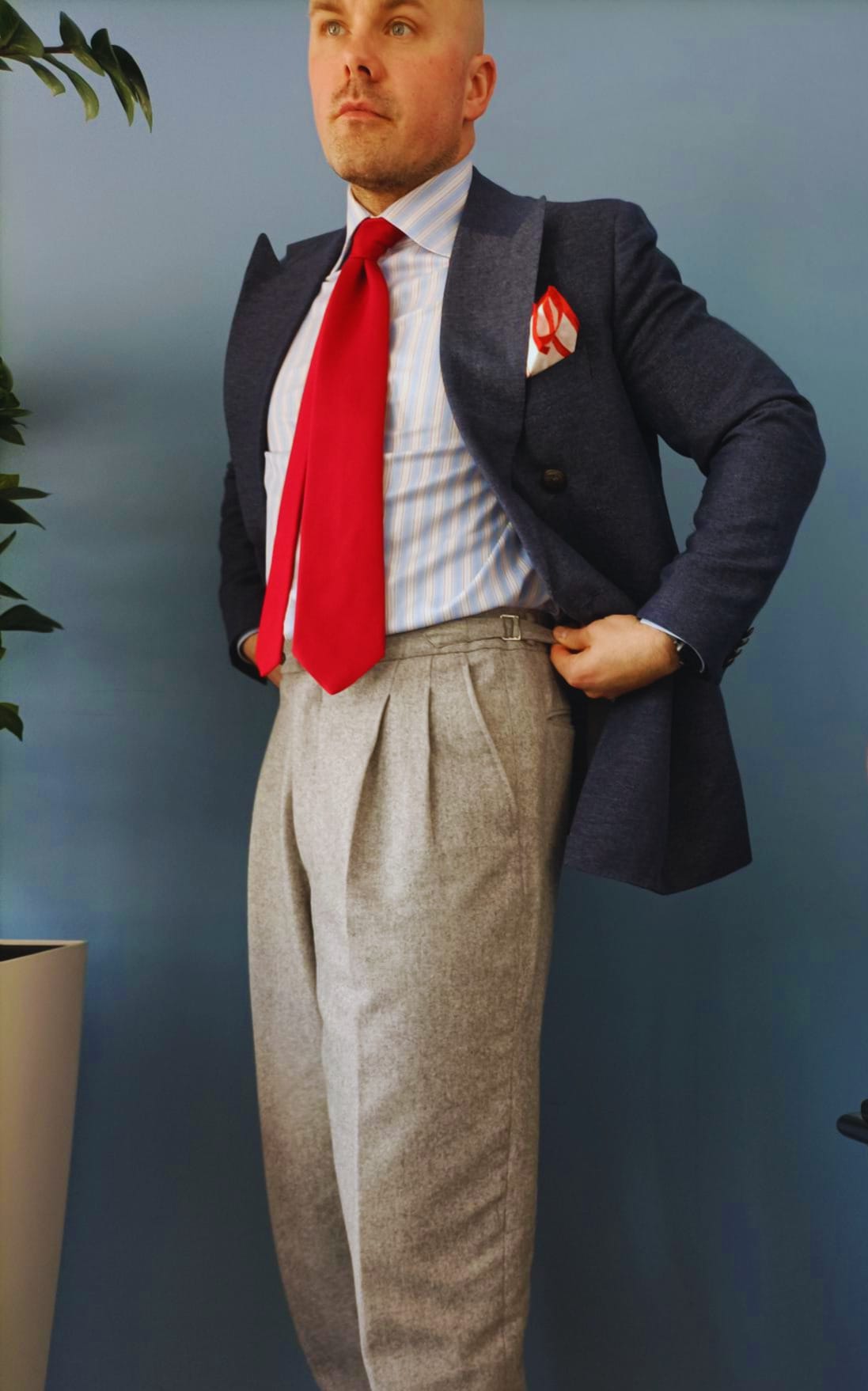
Navy builds the sentence. Red decides how it ends.

There are men who dress. And there are men who compose.
The difference is not in price, nor in brand, nor even in fit—though all three matter. The difference lies in intention. In whether the outfit is assembled… or written. Because the best looks are not outfits. They are sentences. And like any sentence, they need structure before they can carry meaning.
Navy is structure. It is the grammar of menswear. The quiet backbone that holds everything together without asking for attention. A navy jacket does not try to impress you. It assumes you already understand. It speaks in full stops, not exclamation marks. There is a reason navy dominates boardrooms, negotiations, and moments where credibility is non-negotiable. It stabilizes the message. It tells the room: this man is in control of himself before he attempts to control anything else. But structure alone is not enough. A sentence made only of correct grammar is still… forgettable.
This is where red enters.
Not as decoration, but as decision.
Red is not neutral. It does not blend. It interrupts. A red tie cuts through navy like a deliberate thought—something chosen, not inherited. It introduces tension into the composition.
And tension, when controlled, is what creates presence.
Too much red, and the sentence becomes noise. Too little, and it says nothing at all. But placed correctly—at the knot of a tie, in the fold of a pocket square—it shifts the entire meaning of the look.
Suddenly, the man in navy is no longer just reliable. He is intentional.
There is also something else at play here, something less discussed and more instinctive. Navy reassures. Red tests.
Together, they create a subtle contradiction. A visual paradox that makes people look twice without knowing exactly why. You appear grounded, but not passive. Composed, but not predictable. In a world of either/or, this combination suggests both.
And that is where style begins to move beyond clothing and into communication.
Of course, none of this works without restraint. The modern temptation is to overstate—to add, layer, amplify. More color, more texture, more “personality.” But good style, like good writing, knows when to stop.
A navy blazer, a well-chosen shirt, a red tie that knows its place.
Nothing fighting for attention. Nothing apologizing either. Just a clear sentence, properly constructed, ending exactly where it should. Because that’s the real point.
You are not dressing to be noticed. You are dressing to be understood—on your own terms. And sometimes, all it takes is one color to decide how the story ends.